
You had the bigger room. Your regulars showed up. Someone dropped a huge gift with twenty seconds left, and you still lost by a few thousand points.
If you’ve ever walked away from a battle wondering how that happened, you’re not alone. Most creators assume they lost because the other host had bigger supporters or a more generous community. It’s an easy conclusion to reach, but it isn’t always correct.
Creators who win battles consistently aren’t always the ones with the biggest audiences with the deepest pockets.
More often than not, they’re the ones who understand how TikTok’s battles actually works. They know when points matter most, how to coordinate their community, and how to turn the same amount of gifting into a much higher score.
The frustrating part is that almost nobody explains this. Most creators learn through trial and ‘terror’, trying to piece things together themselves after dozens of battles. Only making the same mistakes, losing battles they could have won and never quite understanding why.
Luckily, GravitasQ Creators get to truly understand how TikTok LIVE battles really work, why timing matters more than most creators realise, and the practical strategies you can use to give your community a better chance of winning your next battle.
And we’re about to break it down for you…
How a TikTok Battle Actually Works
The basics first, because even hosts who have battled for months will benefit from knowing the mechanics.
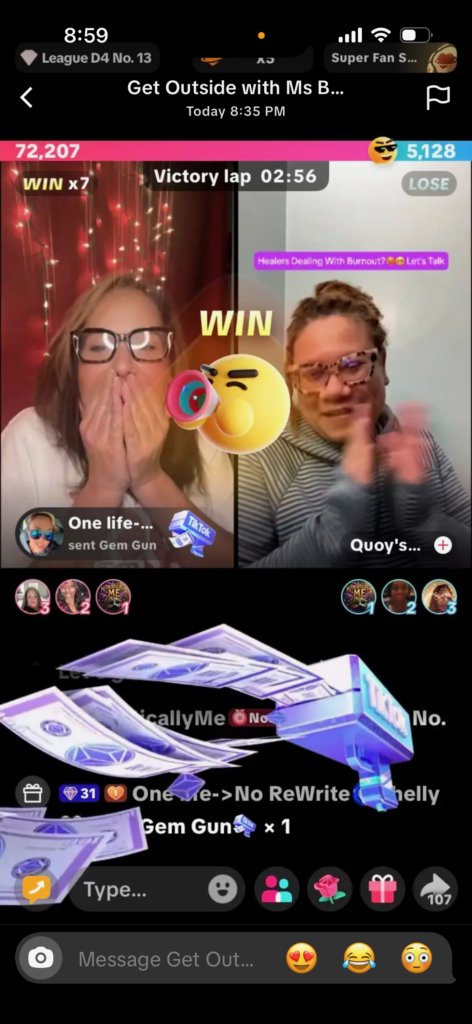
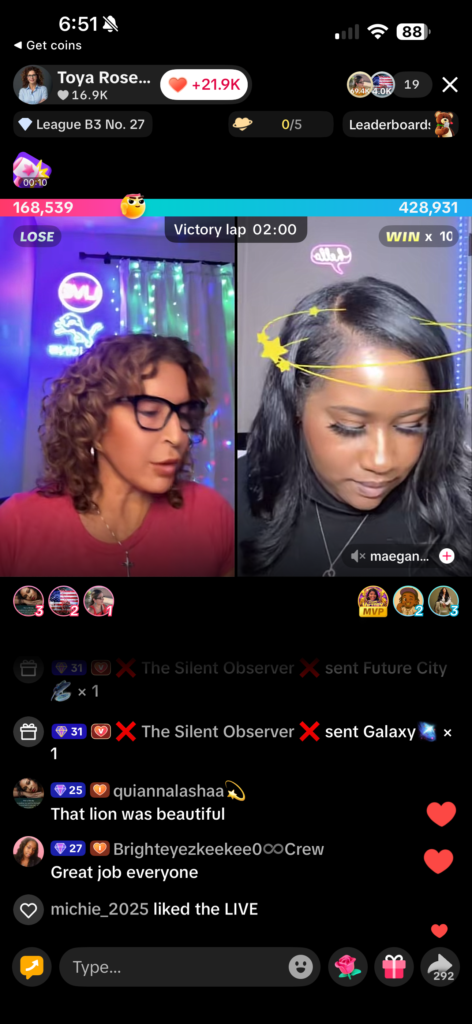
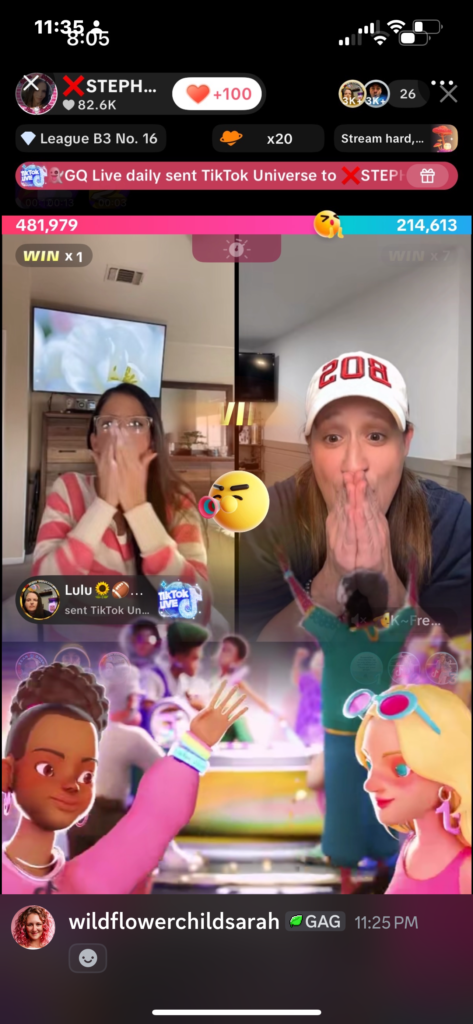
A battle runs out of a co-host session. You invite another host into your LIVE, the screen splits, and a Match option appears. Tapping it starts a five minute competition, and the winner is decided by gift points. Not viewers. Not likes. Not follows. Gift points, and nothing else.
Every gift carries a point value, running from a single point at the bottom of the range to 44,999 at the top. Your side’s total is whatever your room sends during those five minutes.
Two things worth knowing before you go further.
- Winning gives you Victory status, but it does not raise the payout value of the gifts you received beyond what they were already worth.
- And battles lift engagement, but they will not push you onto the For You page on their own without retention behind them.
Battles are a community tool and an earnings tool. They are not an algorithm cheat code, and anyone telling you that is selling you something.
So if the gifts are worth the same either way, why does winning matter? Because a room that wins together comes back. Streaks build identity. Your regulars start turning up at battle time specifically.
And that is the real benefit to you. A room that shows up for battles is a room that gifts more often, not just on battle nights, because winning together turns casual viewers into invested regulars. Consistent battles build the kind of loyal, recurring support that steady income is actually made of. Winning is not the prize. The community it builds is.
The Scoring Layer Nobody Explains
Up to this point, battles probably sound fairly straightforward. Two or more creators compete, viewers send gifts, and the side with the most points wins.
That’s only part of the story.
Hidden beneath the surface are mechanics that can completely change the outcome of a battle. Most creators don’t discover them until they’ve lost enough battles to spot the pattern themselves.
Here is where battles stop being a popularity contest.
During a battle, the scoring is not flat for the full five minutes. There are windows where gifts are worth double or triple their normal points, commonly called speed rounds. If your Gifters send during the window your points multiply. If they send outside it you get face value.
Sitting alongside that is a power-up layer. Your top gifters can earn tools that change the maths mid-battle. The set includes shields, magic mist, a stun hammer, boosting gloves and a time-maker. Some amplify your own points. Some interfere with the opposing side’s scoring. Some buy you time.
Most hosts have watched these icons flash across the screen for months and never learned what a single one does.
That is the whole problem in one sentence. Your gifters cannot use a tool they do not understand, and they will not ask, because asking in a busy chat feels like admitting you are new. So the tools sit unused, the multiplier windows come and go unmentioned, and the room sends gifts on instinct at random moments across five minutes.
Meanwhile the other host is calling it out loud. “Hold. Hold. Now.”
That is the entire difference. It is not money. It is coordination.
Why the Biggest Gift Does Not Win the Battle
This is the part that costs hosts the most, and is completely counterintuitive.
Say a Gifter has a set amount they are willing to spend on your battle. The instinct is to send it as one large gift, usually near the end, for the drama. It feels generous. It feels decisive.
It is close to the worst possible use of it.
One gifter broke a 30,000 spend into six portions of roughly 5,000, timing each one to land inside a multiplier window. Those portions landed on the board as around 70,000 points. Same spend as a single big gift. More than double the score.
A single large gift can only ever catch one window. Split into portions, the same value catches several. This is why a room of modest gifters who know the timing routinely beats a room with one big spender who does not.
It applies everywhere on the platform. A singer’s room sending during a speed round while she holds a note beats the same room sending whenever the mood takes them. A GQ gamer’s chat coordinating a push at the two minute mark beats the same chat reacting to whatever just happened on screen. A fitness host counting her room into a window during the last set of a challenge beats the same room gifting on applause. The content changes. The maths does not.
The lesson for your Gifters is simple and it is worth saying out loud on every battle: spread it, and send it when I tell you.
The Mistakes That Lose Winnable Battles
Most lost battles are not lost on the scoreboard. They are lost by the host making the same handful of errors without realising it. If you recognise yourself in any of these, that alone puts you ahead of most of the room.
- Battling without teaching your room the game. This is the big one, and everything else is downstream of it. A room that does not understand how battles are scored cannot help you win one, no matter how much they like you. Most hosts never close this gap, which is exactly why it decides so many battles.
- Letting a supporter spend it all in one go. The instinct is to cheer the single big gift. It feels generous and it feels decisive. It is neither, and a room that does this is leaving points on the table it will never see, every single battle.
- Burning everything in the first ninety seconds. New hosts go all in early, then spend the back half watching the gap close with nothing left to answer it. Five minutes is far longer than it feels when you are ahead and far shorter than it feels when you are behind.
- Ignoring the power-ups entirely. Those icons flashing across the screen are not decoration. Hosts who treat them as background noise are handing a live advantage to anyone who does not, and most hosts have never learned what a single one of them does.
- Entertaining your opponent instead of your room. The most common unforced error there is. Two hosts get on well, start playing to each other, and both rooms quietly go silent. Your points come from your side of the screen, and the moment you forget that, you are working for the other host.
- Battling on a shaky connection. An unstable connection can end the match outright. If you drop mid-battle, that is the battle gone, however well it was going.
Every one of these is avoidable. Avoiding all of them at once, live, with the clock running, is the part that takes practice.
One Strategy Doesn't Win Every Battle
The scoring is identical for everyone. The room management is not.
A one against one battle is the standard, and it is where you should learn. A box battle puts multiple hosts on screen together, which is faster, louder and much harder to lead, because your room’s attention is split across several people at once. Leagues add a competitive ladder over time.
Where it genuinely differs is pacing.
A sing-off battle has natural peaks. You build to a chorus, and that is your window. The music does the pacing for you, so your job is to line the multiplier up with the moment your room is already feeling something.
A DJ set battle has a longer, flatter energy curve. There is no obvious crescendo unless you build one, which means you have to be far more explicit about calling the push.
A gaming battle is dictated by the match. You cannot always schedule a window around a team fight, so GQ gamers tend to do better calling pushes off the clock rather than off the gameplay.
A chat host has the least to lean on. No chorus, no drop, no match to react to. The peaks come out of the conversation itself, a story landing, a reveal, a reaction the room has been waiting for, and they arrive when they arrive rather than on cue. So the chat host’s skill is catching those moments as they happen and pulling the room in on them, instead of building a window in advance.
Same five minutes. Same maths. Completely different room to run.
Not sure which pacing suits your format? That is exactly the sort of thing a Creator Manager works through with you once, rather than something you piece together across forty lost battles.
The Hidden Reason Your Match Button Disappears
This one catches people out badly, because it looks like a bug.
You go LIVE as normal. Everything works. But the Match option is missing, and you assume the app is playing up.
It usually is not. Accounts carrying Community Guidelines violations can have Match disabled while still being allowed to go LIVE perfectly normally. The rest of your account looks healthy, so nothing points you towards the real cause.
One more practical note. An unstable connection ends the match outright. If you drop mid-battle, that is the battle gone.
What Changes When You Battle With GravitasQ Behind You
Everything you’ve read in this guide can be learned through experience. The problem is that experience usually comes after losing a lot of battles.
That’s where GravitasQ comes in.
Instead of figuring it all out on your own, you get a 1-2-1 Creator Manager who helps you understand what happened, refine your strategy and improve from one battle to the next.
You’ll get:
- Battle reviews that show exactly where momentum was lost.
- A pacing strategy tailored to your content, whether you’re a gamer, singer, DJ, battle or chat host.
- Access to a network of creators across the UK, Ireland, USA, Canada, Australia and New Zealand for better, more consistent battles.
- Practical coaching that helps you train your community to battle smarter, not just harder.
As an official TikTok partner, GravitasQ gives you guidance based on platform expertise, not guesswork.
Your next battle does not have to go the same way.
Ready to win more battles? Click the link to apply to GravitasQ and start turning losses into more wins.
TikTok LIVE Battle FAQs
You win a TikTok LIVE battle by earning more gift points than your opponent before the timer runs out. Winning consistently takes more than simply asking for gifts. Teach your viewers how the battle works, call out multiplier windows, use power-ups strategically and guide your community on when to push.
You need access to TikTok LIVE and the co-host Match feature, another eligible creator to battle and a stable internet connection. The Match feature may not be available on every account and can be restricted if your account has Community Guidelines violations.
Choose your opponent in advance, test your connection and make sure you understand the scoring tools available to you. Let your community know when the battle is happening, explain how they can participate and plan how you’ll keep the room engaged from beginning to end.
A standard TikTok LIVE battle usually runs for five minutes. During that time, viewers support either creator by sending gifts that add points to the scoreboard. Some battle formats and special events may work differently, so check the match settings before starting.
Likes can help generate activity and engagement in your LIVE, but they do not normally add to your battle score. The winner is determined by the gift points collected during the match, which is why coordinating your gifting strategy matters.
Winning does not automatically increase the cash value of the gifts you receive. Your earnings are still based on the rewards generated from those gifts. The bigger benefit of winning is the community excitement, loyalty and momentum that successful battles can help create.